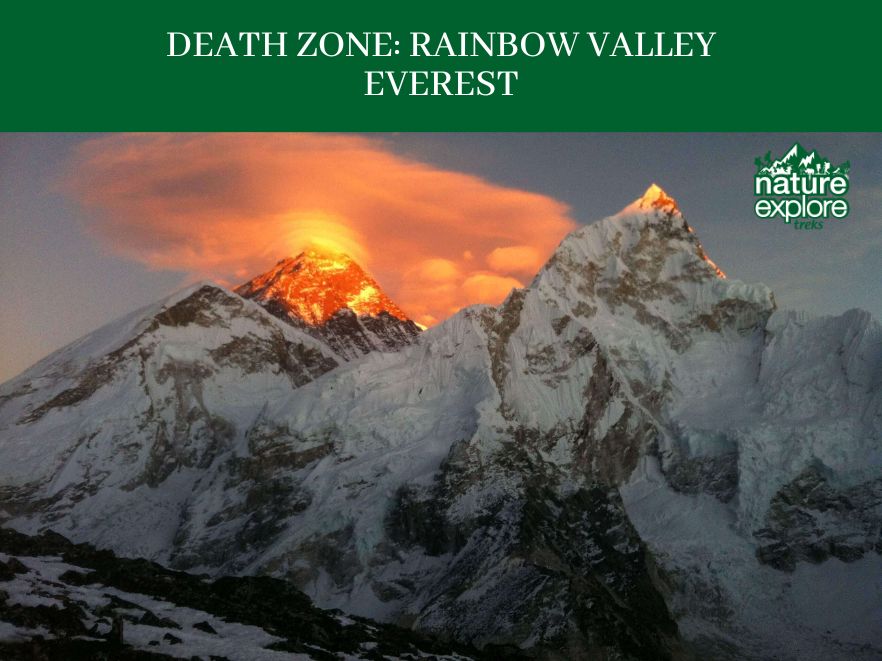
Today we will find out the bitter truth of Mount Everest, despite the commonly held belief that Everest is a symbol of purity and goodness. Mount Everest has a hidden Dark secret beneath its pristine snow-capped peak.
Have you ever heard about the "Rainbow Valley of Everest"?
Yes, there is a place called Rainbow Valley that lies under the white roof of Everest, hiding its dark secret
Table of Contents
What is The Rainbow Valley of Everest?
The term "Rainbow Valley" describes a sloped area just below the "death zone," or the area over 8000 meters, on the summit of Mount Everest. Rainbow Valley is a dangerous part of the climb because of the extremely small track capable of holding one person at a time and severely low oxygen levels. Due to the extreme conditions, mountaineers frequently make mistakes and rush, and a fall from the death zone can lead directly to Rainbow Valley. Rainbow Valley is the largest graveyard in the world, holding 200+ brave souls who try to conquer the world.
Sadly, some 200 climbers ended up in the Everest death zone and fell into Rainbow Valley. It's a harsh reminder of the risk of mountain climbing and the significance of being prepared, cautious, and careful.
Why is It Called The" Death Zone"?
Although the term "Rainbow Valley" is not commonly used to refer to Mount Everest's death zone, some theories suggest it may have originated from the colorful clothing and equipment used by those brave souls who tried to conquer Everest but failed. But their bodies are still in the area, appearing to be a rainbow against the snow. Rainbow Valley tries to show the power of nature against humans. It's important to realize that the death zone is a dangerous mountain area due to its high altitude and lack of oxygen and that it shouldn't be ignored or underestimated.
In general, Throughout the years, many climbers have lost their lives in the dangerous region of Mount Everest.
The Reason behind Rainbow Valley Everest Being Dangerous:
Due to various factors, many climbers pass away in the Rainbow Valley of Everest. Some suffer from altitude sickness and frostbite, while others fall victim to snow off the narrow trail. Additionally, some climbers get lost in the area, and others run into problems with their equipment or lack of preparation. In such high-altitude and dangerous conditions, even skilled climbers make mistakes or can face unexpected challenges.
Various factors make the Rainbow Valley Everest difficult and dangerous, some of them are as follows:
.jpg "High Altitude")
High Altitude
First, the area is very high in altitude—more than 8000 meters—so the oxygen content is very low. If not treated right once, this could result in altitude sickness, which is potentially lethal. Due to high altitude, there is a high risk of altitude sickness. At 8,000 feet of altitude, climbers are susceptible to acute mountain sickness, sometimes called altitude sickness. It is due to a fall in barometric pressure, which causes the air to be too thin and oxygen molecules to spread out, resulting in insufficient oxygen delivery to the brain. To protect themselves from altitude sickness, climbers must recognize the signs and take appropriate measures.
In addition to difficulty breathing and walking, climbers may cough up liquids, be confused, or even lose consciousness. As a result, the body's organs start to shut down. The risk of stroke can also rise due to the thickening of the blood and dehydration from altitude sickness.
Additionally, the effects of altitude sickness can impair judgment, making every move at higher altitudes a race against the clock.
Area's topography
Second, the area's difficult and extremely dangerous geography makes it difficult for climbers to reach the mountain's summit. Even for skilled climbers, the terrain's steep slopes, sharp ridges, and deep crevasses make it challenging for navigation. To move securely on this terrain, climbers must utilize specific gear and techniques, including crampons, ropes, and harnesses.
The possibility of a deadly fall or injury due to a small mistake is one of the most serious difficulties climbers encounter on this terrain. The ground is uneven; even a small slip or error might cause a deadly fall or serious injuries. Climbers must be highly skillful and cautious and maintain focus and concentration to move the terrain safely. Remember that at that height, the only person who can assist you is yourself. Nobody can help you, not even a friend or family member. As climbers must navigate around each other in a tight location, the chance of incidents such as rock falls, avalanches, or slips increases.
The bottleneck condition can cause climbers to spend more time at higher altitudes, increasing their chance of experiencing altitude sickness and other related health issues. The treacherous terrain and crowded conditions create a difficult and potentially dangerous atmosphere for climbers aiming to reach the mountain's peak.
Weather Condition
Climbers find preparing for the mountain's weather difficult because it can be incredibly unexpected and change quickly. Because of its high height, the mountain is particularly vulnerable to rapid weather changes, including storms, strong winds, and snowfalls. These atmospheric conditions can lead to deadly scenarios for mountain climbers trying to reach the top.
Climbers may face severe challenges due to sudden storms and strong winds. In addition to making navigation more difficult, strong winds and snowfalls can make it impossible to stay balanced and stable on high terrain. Lightning strikes, which can be fatal at high altitudes, are another potential risk that comes with storms.
Weather conditions can have major long-term implications in addition to the critical risks they bring with them. Snowfall, for example, can generate fragile snowpacks on steep slopes, increasing the risk of avalanches. Additionally, the buildup of snow and ice on the trail can make navigation more challenging and raise the possibility of slips and falls.
Weather conditions must be closely monitored by climbers, who must be ready to change their plans or retreat if they become too dangerous. The unstable weather conditions on the mountain increase the possibility of a difficult and risky trek.
Other Health Hazard
In addition to altitude sickness, climbers who attempt to ascend Mount Everest and other high-altitude mountains may have many severe health issues that could risk their lives.
One of these issues is snow blindness, which develops when the eyes are exposed to a lot of UV radiation and may result in temporary or permanent eye damage. Snow blindness is a common issue for climbers on Mount Everest because of how the reflected snow and ice can amplify the effects of UV light.
Climbers commonly experience dizziness and a lack of oxygen. Because the body has problems getting adequate oxygen at high altitudes, symptoms including dizziness, confusion, and poor judgment may occur. Climbers who experience hypoxia may become unconscious or die if oxygen levels continue to fall.
Another severe health issue climbers may have in exposure to exceptionally low temperatures is frostbite. Body tissue freezing can result in death or severe injury. Climbers must take precautions to avoid frostbite by wearing suitable gear and taking frequent stops to warm up.
Climbers exposed to extreme heat and dehydrated may develop hyperthermia, often known as heatstroke. Failure of the body's cooling systems can result in dangerously high body temperatures, convulsions, and even comas.
The death zone's tough conditions can also prevent climbers from getting adequate sleep, which can result in a sleep coma. The body needs enough sleep to function effectively, and not getting enough sleep can affect one's judgment and ability to make decisions, which increases the likelihood of injury and accidents.
Conclusion
In conclusion, climbing Mount Everest is difficult and dangerous, especially in the death zone. Climbers face severe risks because of the high altitude, rocky terrain, and unpredictability of the weather, including the possibility of developing potentially deadly health problems.
As a result, to minimize the potential danger, climbers must carefully set up their expedition, get the appropriate training, and implement all necessary safety measures. Paying attention to their bodies and taking breaks as needed is crucial to prevent weariness and dehydration.Climbers face difficult and dangerous circumstances in the Mount Everest death zone. The high altitude and adverse weather can bring on numerous health issues that could be fatal. To stay safe when attempting to summit the mountain, climbers must be aware of these threats and adopt the necessary safety measures.
Finally, Since there is a significant chance of death in a danger zone, having insurance might give the climber's family financial support in the unfortunate event of an accident.
In conclusion, considerable planning, preparation, and cautiousness are necessary for climbing Mount Everest. To protect their safety and lower the likelihood of danger, climbers must be aware of the risks and take all required precautions.

- Best price guaranteed.
- Your money is 100% safe.
- Deep local knowledge and on ground attendance.
- We are available around the clock.
- All trip are fully customizable.
- Guaranteed Departure on Every Booking.
- You can schedule your own departure dates.
- All trip, we can help you to make fit on your budget.
- Company based in Nepal.